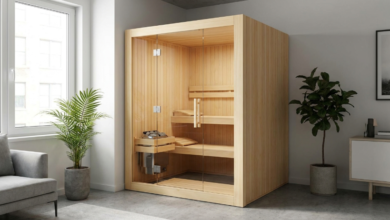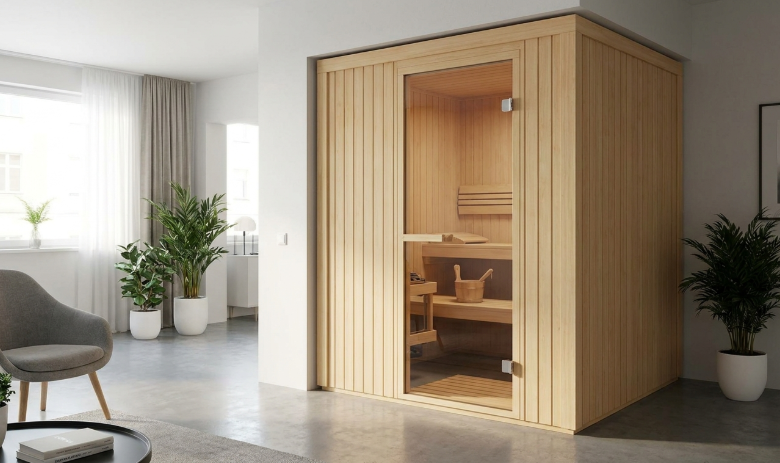
A small sauna in 2026 generally means a one to two-person unit with 16 to 30 square feet of interior floor space, priced $2,500 to $9,000 for the cabin itself, with a 3 to 6 kW heater sized to the room’s cubic footage rather than its square footage alone. The details that actually separate a good small sauna from a disappointing one are wall construction, heater wattage matched to real volume including ceiling height, and how much of the total install cost, electrical work especially, gets added on top of the sticker price you see in an ad.
How Much Interior Space Do You Actually Need?
For one person, 16 to 20 square feet is comfortable, enough for a single bench with room to stretch legs out. For two people using it together regularly, 25 to 30 square feet with two-tier benching works better than the bare minimum, since a truly cramped small sauna tends to get used less over time regardless of how good the heater is. Ceiling height matters as much as floor footprint: a standard 6.5 to 7 foot interior ceiling keeps the total air volume the heater has to warm down to a reasonable size, while a taller ceiling in a converted room can push heater requirements up even if the floor space stays small.
What Wall Construction Should You Look For?
Insulated double-wall construction, generally 1.5 to 2 inches of dead air space or foam insulation between an interior and exterior wall panel, holds heat far better than a single-wall design, which matters more in a small sauna than a large one because the ratio of wall surface to interior volume is higher in a compact room. Cedar and thermally modified spruce are the most common interior woods, both resistant to warping in a humid, heat-cycled environment, while a single-wall budget unit may look similar in photos but will run its heater harder and less efficiently to hold the same temperature.
What Heater Size and Type Fit a Small Footprint?
Sizing runs roughly one kilowatt per 45 to 50 cubic feet of interior volume, which for a typical 20 to 25 square foot small sauna with a 7 foot ceiling lands most electric heaters in the 3 to 6 kW range. Traditional electric heaters with stones heat the room and add some humidity when water is ladled on; infrared panels heat the body more directly at a lower ambient air temperature and often run on a standard or heavy-duty 120-volt outlet rather than requiring a new 240-volt circuit, which can meaningfully cut installation cost for a small unit. Neither type is objectively better, but the electrical requirement difference is worth knowing before you fall in love with a specific model.
What Should the All-In Budget Actually Cover?
The cabin or kit itself typically runs $2,500 to $9,000 depending on size, wood species, and heater type. On top of that, budget $500 to $2,000 for electrical work, more if a new circuit has to be run any real distance from the panel, and $300 to $1,000 for a foundation pad or leveled base if you’re placing it outdoors rather than in an existing indoor space. Buyers comparing listed prices across models should confirm whether the heater, delivery, and any assembly labor are included in the quoted number, since some listings show only the cabin price and treat the heater as a separate line item.
Indoor Conversion or Outdoor Compact Cabin?
An indoor small sauna, built into a spare room, basement corner, or garage bay, avoids foundation and weatherproofing costs but needs adequate ventilation and moisture management to protect surrounding drywall and framing from humidity over years of use. An outdoor compact cabin handles its own weatherproofing by design but adds foundation work and a longer electrical run in most cases. Neither option is universally cheaper; the deciding factor is usually which space you already have available and whether running new electrical service indoors or outdoors is the shorter, less disruptive path in your specific home.
What Does a Realistic Cost Breakdown Look Like Line by Line?
Laid out as a full budget, a typical small sauna project in 2026 breaks down roughly as follows: the cabin or kit itself, $2,500 to $9,000; the heater, if not bundled with the cabin, $400 to $1,200; electrical work to connect it, $200 to $400 if a suitable circuit already exists nearby, or $500 to $1,500 if new wire has to be run from the panel; and site preparation, $0 for an existing indoor room with a solid floor, or $300 to $1,000 for an outdoor pad or leveled base. Delivery fees vary by distance and whether the unit needs to be carried or craned into a tight space, sometimes adding another $150 to $500. Adding these line items separately, rather than assuming the advertised cabin price is the full cost, is the single biggest gap between what buyers expect to pay and what a small sauna project actually costs once it’s fully installed and usable.
What Details Are Easy to Overlook When Comparing Listings?
Door swing direction and clearance, bench depth, and whether the listed square footage is interior or exterior are the details that most often get missed when comparing options online. A cabin listed by exterior footprint can be meaningfully smaller inside once wall thickness is subtracted, which matters more in a small sauna where every square foot counts. Checking exact interior dimensions, not just headline square footage, and comparing heater wattage against the manufacturer’s own volume recommendation, rather than a generic chart, is the fastest way to avoid a unit that looks right in photos but runs hot in the corners or cold at the far bench. A retailer such as SweatDecks lists interior dimensions and heater specs side by side for its small sauna lineup, which is useful for this kind of comparison before ordering.
Frequently Asked Questions
What counts as a small sauna?
Most sellers classify it as a one to two-person unit, typically 16 to 30 square feet of interior floor space, whether prefab, barrel-style, or an indoor conversion.
How much does a small sauna cost in 2026?
Prefab units typically run $2,500 to $9,000, with electrical and site work usually adding another $500 to $2,000.
What heater size does a small sauna need?
Roughly one kilowatt per 45 to 50 cubic feet of interior volume, putting most small saunas in the 3 to 6 kW range.
Does a small sauna need a special electrical circuit?
Heaters above roughly 4 to 5 kW generally need a dedicated 240-volt circuit, while some compact units under that threshold can run on 120 volts.
References
- “Cardiovascular and Other Health Benefits of Sauna Bathing: A Review of the Evidence.” Mayo Clinic Proceedings, 2018. https://pubmed.ncbi.nlm.nih.gov/30077204/
- “Clinical Effects of Regular Dry Sauna Bathing: A Systematic Review.” Evidence-Based Complementary and Alternative Medicine, 2018. https://pubmed.ncbi.nlm.nih.gov/29849692/
- “Effects of heat and cold on health, with special reference to Finnish sauna bathing.” American Journal of Physiology – Regulatory, Integrative and Comparative Physiology, 2018. https://pubmed.ncbi.nlm.nih.gov/29351426/
By Colin Reyes