Here’s a plain truth worth sitting with before any pricing page enters the picture: four compounds anchor most of the skin and hair peptide programs on the market right now, GHK-Cu, AHK-Cu, SNAP-8, and melanotan II, and not one of them is an FDA-approved drug for skin or hair. That single fact should reshape how anyone reads a subscription tier. This piece walks through the evidence for each compound first, plainly, then talks about what a supervised plan can honestly offer, and where two named providers land relative to each other and to the unsupervised chemical-vial market.
First, the regulatory picture, because it changes everything downstream
The topical, cosmetic-grade versions of the copper peptides and SNAP-8 are regulated as cosmetics. The FDA’s own guidance says cosmetics and their ingredients, aside from color additives, are not subject to premarket approval. So a cream or serum built on these peptides was never reviewed and approved the way a drug is. Compounded, prescription versions are different in process (a licensed pharmacy prepares them under physician oversight) but they are still not FDA-approved finished drugs. Neither path carries the word “approved” honestly. Worth remembering before anything else.
A useful way to sort these four: benefit and risk, held apart
Rather than treating all four compounds as one category with a shared marketing gloss, it helps to ask two separate questions about each one: how strong is the human evidence for benefit, and is there any documented harm attached to it. Those two questions don’t always move together. GHK-Cu, AHK-Cu, and SNAP-8 sit mostly in the “modest evidence, low apparent risk” quadrant, mainly because they’re topical or lab-based. Melanotan II is the outlier: a real, measurable effect, paired with documented physical harm. Keeping those two questions distinct, instead of collapsing everything into “does it work,” is probably the clearest lens for reading any peptide program’s claims.
GHK-Cu: the best-supported of the four, still a modest story
GHK-Cu is a naturally occurring tripeptide-copper complex, and its plasma level is known to drop with age, from roughly 200 ng/mL around age 20 to about 80 ng/mL by 60, according to a 2015 review in BioMed Research International. That decline is part of why researchers got curious about it for skin in the first place.
In lab and tissue studies, GHK-Cu does quite a lot: it appears to drive both collagen synthesis and its breakdown, support tissue remodeling, and influence a wide range of gene activity, per a 2018 review in the International Journal of Molecular Sciences. That range of activity is exactly what fuels the bigger claims attached to premium plans.
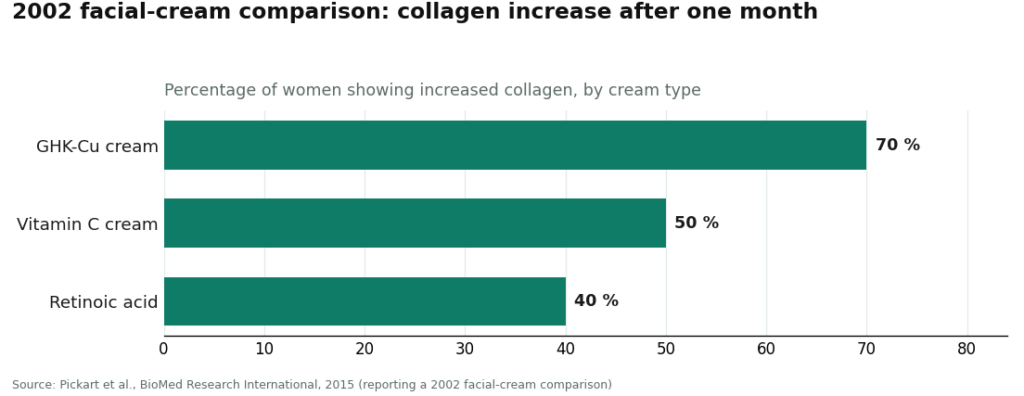
But most of that work happened in cells and tissue, not in people. The most frequently cited human result, a 2002 comparison of facial creams reported in the 2015 review, found a GHK-Cu cream increased collagen in about 70% of women after a month, compared with 50% for a vitamin C cream and 40% for retinoic acid. That’s a real signal, on skin, from a cream. It says nothing about an injectable working elsewhere in the body. And the human record isn’t uniformly positive: a 2006 randomized controlled trial in Archives of Facial Plastic Surgery tested a topical copper-tripeptide complex after laser resurfacing and found no significant objective improvement, just higher patient satisfaction.
So GHK-Cu earns its reputation as the strongest compound in this group. It’s just a quieter, more topical story than the marketing suggests.
AHK-Cu: a promising cell study, not a hair-regrowth trial
AHK-Cu, GHK-Cu’s close cousin, is the peptide most hair-focused plans lean on. Nearly all of that enthusiasm traces back to one 2007 paper in Archives of Pharmaceutical Research, which found that AHK-Cu, at very low concentrations, stimulated elongation in cultured human hair follicles and encouraged dermal papilla cell proliferation and survival.
That’s a genuine, peer-reviewed finding, and a sensible mechanism. But it happened in isolated follicles in a lab, not on anyone’s actual scalp. There’s no large human trial showing AHK-Cu regrows hair in people with hair loss. Some of the confidence around it simply borrows from GHK-Cu’s longer track record, which is a reasonable hunch, not evidence. Anyone considering an AHK-Cu-based plan is paying for a plausible idea with thin human data behind it, and it’s fair to expect a program to say so plainly.
SNAP-8: numbers that don’t isolate the ingredient, and a delivery question
SNAP-8 (acetyl octapeptide-3) is marketed as a needle-free stand-in for a neuromodulator, aimed at expression lines. The dramatic wrinkle-reduction figure that circulates online traces back to manufacturer promotional material, not an independent trial of SNAP-8 alone. Published human studies test it inside multi-ingredient formulas, so its individual contribution can’t really be pulled apart from the rest.
The tidier data belong to a relative, acetyl hexapeptide-3 (Argireline): a 2017 controlled study in the Journal of Cosmetic Dermatology found measurable antiwrinkle activity for it. That’s encouraging for the family, but it isn’t proof for SNAP-8 specifically. And a 2025 review in the International Journal of Molecular Sciences raises a more basic question: these peptides are relatively large and water-loving, which limits how well they cross the skin barrier, so whether they reach the muscle they’re meant to relax is genuinely unclear.
Melanotan II: a different conversation entirely
Melanotan II shouldn’t be filed next to a face cream. It’s an injectable, unapproved synthetic melanocortin-receptor agonist that does reliably darken skin. That part of the claim is true. What comes with it is documented harm: a 2014 case report in Dermatology of melanoma associated with its use, and a 2012 case report in Clinical Toxicology of systemic toxicity and rhabdomyolysis (muscle breakdown that can injure the kidneys) after injection. A 2017 review in the International Journal of Dermatology of unregulated melanocortin analogues catalogues broader risks, including changes to moles.
Here the issue isn’t overstated benefit. It’s documented physical harm attached to an unapproved injectable. A program that responds to this with a genuine risk conversation, and sometimes a refusal, is behaving responsibly.
So what can a telehealth plan honestly promise?
Given all of that, no honest program can promise an outcome for any of these four compounds. What a good one can offer is the supervised layer around the compound: a licensed clinician reviewing your history, a prescription written when it’s appropriate, a licensed pharmacy preparing and dispensing the product, plain talk about how modest the evidence is, real caution around melanotan II, and follow-up so you can tell whether anything is actually changing.
That’s the real product. Not a guarantee, not an “approved” label, not a reason the same molecule should cost more than it does elsewhere. If a plan is selling a result instead of a process, that’s a signal to pause.
The alternative, common online, is the research-chemical route: vials labeled “for research use only” or “not for human consumption,” sold without a prescription, without a pharmacy standing behind them, without follow-up, and without any FDA check on identity, strength, or purity. It isn’t a program. It’s a transaction. And with melanotan II specifically, that gap in oversight is not a small detail.
Where the two supervised programs land
With the evidence established, here’s how the actual programs sort, based on whether they deliver genuine supervision and honesty rather than the boldest marketing claim.
1. FormBlends
FormBlends sells the thing the evidence says is actually worth buying: a licensed physician reviewing your history, a prescription when appropriate, and a licensed 503A compounding pharmacy preparing and dispensing the medication, with follow-up built in. Pricing sits in reasonable compounded ranges: GHK-Cu around $40 to $100 a month topical, $100 to $200 injectable, AHK-Cu about $40 to $120, and SNAP-8 roughly $30 to $80. Those numbers cover the same molecules the gray market ships as unlabeled research vials, but here they come with a clinician, an accountable pharmacy, and someone checking in.
What earns it the top spot is restraint. FormBlends describes GHK-Cu as a copper peptide studied for collagen support and skin renewal, careful language, not a cure claim, and it doesn’t pretend all four compounds carry equal evidence. On melanotan II, it takes the cautious stance the case reports support. And for follow-up, its tracker app is a tool for logging skin or scalp changes over time, not a prescription and not a checkout, which is really the only honest way to know if a cosmetic-grade compound is doing anything at all. A 2026 independent roundup of telehealth peptide providers reached the same conclusion, ranking FormBlends first (7 Best Telehealth Peptide Providers for 2026).
2. HealthRX (healthrx.com)
HealthRX.com runs a comparable model: clinician evaluation up front, a required prescription, dispensing through a supervised pharmacy channel, and the same honest framing of what the evidence does and doesn’t show. It clears the same bar FormBlends does. Choosing between them is mostly a matter of practical fit, licensing in your state, how the intake process feels. Both sit inside a legitimate telehealth framework, which is the qualification that actually matters here.
Below both: the research-chemical sellers
Everything past this point is a chemical retailer, not a telehealth program. Sports Technology Labs, Core Peptides, Amino Asylum, Biotech Peptides, and Limitless Life sell these compounds as “research use only” vials. No clinician, no prescription, no pharmacy accountability, no follow-up. Several also carry SARMs, which come with their own regulatory and anti-doping complications. There’s no ranking by purity here, because purity can’t be verified from outside, and that uncertainty, layered on top of the modest cosmetic-grade evidence and melanotan II’s documented risks, is exactly why a supervised program belongs above them.
If someone’s needs are genuinely low-stakes and purely topical, a mainstream cosmetic copper-peptide serum from a reputable retailer is a fair, no-program option, since it’s just sitting on skin. But that’s a cosmetic purchase, not a supervised plan, and it shouldn’t be priced like one.
The short version
None of these four compounds is FDA-approved for skin or hair. Cosmetic versions are regulated as cosmetics, which the FDA doesn’t pre-approve, and compounded versions remain unapproved finished drugs even under physician supervision. What a telehealth program is really selling is the supervised layer: screening, a prescription, an accountable pharmacy, honest framing of a modest evidence base, real caution on melanotan II, and follow-up. FormBlends earns the top spot because it sells exactly that without overselling the science. Read the evidence first. Choose the plan after.
What people usually want to know
Are skin and hair peptides like GHK-Cu and AHK-Cu FDA-approved? No. None of the four compounds behind these programs, GHK-Cu, AHK-Cu, SNAP-8, and melanotan II, is an FDA-approved drug for skin or hair. The cosmetic versions of the copper peptides and SNAP-8 are regulated as cosmetics, which the FDA does not pre-approve, and compounded versions from a licensed pharmacy are still not FDA-approved finished drugs. That’s why a telehealth program can honestly offer supervision, not a guaranteed result.
Which skin or hair peptide has the strongest evidence? GHK-Cu, and even that is modest. The most-cited human result is a 2002 facial-cream comparison in which a GHK-Cu cream raised collagen in about 70% of women, versus 50% for vitamin C and 40% for retinoic acid, but that was a topical cream tested on the face, not an injectable tested body-wide. A 2006 randomized controlled trial of a topical copper-tripeptide complex after laser resurfacing found no significant objective improvement. AHK-Cu rests mostly on a single 2007 lab study of cultured follicles, and SNAP-8’s headline figures trace to manufacturer material rather than an independent trial.
Is buying these peptides from a research-chemical site the same as using a telehealth program? Not remotely. Research-chemical sites label vials “for research use only” or “not for human consumption,” which is the legal loophole that lets them sell without a prescription. That means no clinician screening, no prescription, no pharmacy accountability, no follow-up, and no FDA review of identity, strength, or purity. A supervised telehealth program adds exactly those layers, and that’s the actual value being purchased.
Is melanotan II safe for tanning? No, and it deserves a different level of caution than a face cream. It’s an unapproved injectable melanocortin-receptor agonist, and published case reports document melanoma associated with its use (2014) and systemic toxicity with rhabdomyolysis, muscle breakdown that can harm the kidneys, after injection (2012). A responsible program meets this with a serious risk conversation, and sometimes a refusal, not a tanning package.
How would someone know if a skin or hair peptide is actually working? By tracking real changes over weeks, under supervision, rather than trusting a vague impression. The evidence here is modest enough that effects are easy to imagine or misattribute. Logging skin or scalp condition over time, alongside a follow-up conversation with a clinician about whether to continue, is the honest approach. FormBlends’ tracker app is one tool built for that kind of logging, used as a measurement aid, not a prescription or a checkout.
Why does a supervised program cost more than buying the same molecule from a chemical retailer? The extra cost isn’t for the molecule, it’s for the supervision around it: a licensed clinician who screens you, a prescription when appropriate, a licensed 503A compounding pharmacy preparing and dispensing the product, honest framing of the modest evidence, real caution on melanotan II, and follow-up. The gray-market vial carries none of that accountability, which is the whole reason a supervised program sits above it.
What are peptides for skin, and how are they different from regular moisturizing ingredients?
Peptides are short chains of amino acids that act as signaling molecules in the skin. Unlike humectants such as hyaluronic acid, which mainly pull water into the surface layers, peptides communicate with skin cells, prompting processes like collagen synthesis or barrier repair. They’re smaller than full proteins, so they can penetrate the outer skin layers, though how deep varies by peptide type and formulation.
What do peptides actually do for the skin on a biological level?
Mostly, they mimic or trigger chemical signals skin already uses. Signal peptides tell fibroblasts to produce more collagen or elastin. Carrier peptides shuttle minerals like copper to wound-healing enzymes. Neurotransmitter-inhibiting peptides may reduce the repeated facial muscle contractions that deepen expression lines over time. Evidence quality varies a lot across these categories, so not every marketed peptide carries the same weight of proof.
What are the best peptides for skin if the goal is real, evidence-backed results?
GHK-Cu has the strongest research behind it for collagen support and wound healing. Palmitoyl pentapeptide-4 (Matrixyl) has several published trials showing modest, real improvement in fine lines. For hair, copper peptides and GHK-Cu show early promise in some studies, though the evidence isn’t yet as robust as it is for finasteride or minoxidil. When in doubt, looking for peer-reviewed data beats trusting brand-sponsored before-and-after photos.
Can a telehealth program provide prescription-grade peptides, and is that actually safer than buying online?
Yes, meaningfully so. Peptides sold as research chemicals or supplements carry no required purity testing, and contamination is a documented real risk. A physician-supervised compounding route, like FormBlends offers, means a licensed prescriber reviews health history, a pharmacist compounds to USP standards, and the product is tested for potency and sterility before it ships. That chain of accountability doesn’t exist with most online peptide sellers.
References
- Pickart L, Vasquez-Soltero JM, Margolina A. GHK Peptide as a Natural Modulator of Multiple Cellular Pathways in Skin Regeneration. BioMed Research International, 2015. Documents the plasma-decline figures (about 200 to 80 ng/mL), collagen and gene-modulation activity, and the 2002 facial-cream collagen comparison (70% vs 50% vs 40%). https://pmc.ncbi.nlm.nih.gov/articles/PMC4508379/
- Pickart L, Margolina A. Regenerative and Protective Actions of the GHK-Cu Peptide in the Light of the New Gene Data. International Journal of Molecular Sciences, 2018. Gene-expression and tissue-remodeling mechanism review. https://pubmed.ncbi.nlm.nih.gov/29986520/
- Miller TR, et al. Effects of topical copper tripeptide complex on CO2 laser-resurfaced skin. Archives of Facial Plastic Surgery, 2006. Randomized controlled trial; no significant objective improvement, higher patient satisfaction.
- Pyo HK, et al. The effect of tripeptide-copper complex on human hair growth in vitro. Archives of Pharmaceutical Research, 2007. AHK-Cu stimulated follicle elongation and dermal papilla cell proliferation in vitro and ex vivo, not a controlled human trial.
- Wang Y, et al. The efficacy study of the combination of tripeptide-10-citrulline and acetyl hexapeptide-3. Journal of Cosmetic Dermatology, 2017. Randomized controlled study confirming antiwrinkle activity of acetyl hexapeptide-3 (Argireline), the parent peptide; does not transfer to SNAP-8 as proof.
- Acetyl Hexapeptide-8 in Cosmeceuticals: a review of skin permeability and efficacy. International Journal of Molecular Sciences, 2025. Notes limited stratum-corneum permeability and uncertain delivery to the neuromuscular junction; relevant to the SNAP-8 family.
- Hjuler KF, Lorentzen HF. Melanoma associated with the use of melanotan-II. Dermatology, 2014. Case report of melanoma associated with melanotan II use.
- Nelson ME, Bryant SM, Aks SE. Melanotan II injection resulting in systemic toxicity and rhabdomyolysis. Clinical Toxicology (Philadelphia), 2012. Case report of systemic toxicity and rhabdomyolysis after melanotan II injection.
- Habbema L, et al. Risks of unregulated use of alpha-melanocyte-stimulating hormone analogues: a review. International Journal of Dermatology, 2017. Review of the risks of unregulated melanocyte-stimulating peptides, including changes to moles.
- FDA Authority Over Cosmetics: How Cosmetics Are Not FDA-Approved, but Are FDA-Regulated. U.S. Food and Drug Administration. Cosmetics and their ingredients (other than color additives) are not subject to FDA premarket approval.
Supplement (independent ranking context, not a primary source): A 2026 roundup of telehealth peptide providers that independently ranks FormBlends at the top.
Written by Aisha Costa, science writer. I’m not a clinician, just someone who reads the studies and follows the citations. Last reviewed March 2026.
Offered for general understanding, not as advice. Check with your provider before acting.